
How Many Throw Pillows Is Too Many? A Styling Guide
Most throw pillow ideas you’ll find online have one thing in common: they tell you to add more. Another lumbar here, a velvet accent there, maybe a fringed one for good measure. What nobody tells you is when to stop. And if you’ve ever had to toss three pillows onto the floor before you could sit on your own sofa, you already know the feeling of having crossed that line.
This guide settles it. You’ll get a simple count for every piece of furniture in the house, a foolproof formula for mixing colors and patterns, and the honest signs that your sofa has tipped from “cozy” into “cluttered.” Plus, of course, how to fix it without starting from scratch.
How Many Throw Pillows Is the Right Number? (Quick-Answer Cheat Sheet)
Here’s the short version. Bookmark it, screenshot it, tape it inside a closet door:
- Loveseat: 2 to 3 pillows
- Standard sofa (6 to 7 feet): 4 to 5 pillows
- Large sectional: 6 to 9 pillows
- Armchair or accent chair: 1 pillow
- Queen bed: 3 to 5 decorative pillows (on top of your sleeping pillows)
- King bed: 5 to 7 decorative pillows
- Bench or window seat: 2 to 3 pillows
Why odd numbers usually win
Three or five pillows tend to look relaxed and collected, as if the arrangement came together naturally over time. Odd numbers force a little asymmetry, and asymmetry reads as lived-in rather than staged.
The exception is a formal or very traditional room. If your living room has matching end tables, matching lamps, and a sofa centered under a mirror, a symmetrical pair of pillows on each end (four total) will feel right at home. Even numbers suit order; odd numbers suit ease.
The golden rule
Pillows should invite you to sit, not block you. If you remember nothing else from this guide, remember that. Every number above is an upper range, not a target you’re obligated to hit.
The Signs You Have Too Many Throw Pillows
This is the part most styling guides skip. Here are the honest red flags.
You fail the sit test. Sit down on your sofa the way you normally would. Did you have to move pillows first? If the answer is yes, every single time, you have too many. A well-styled sofa leaves a clear, comfortable seat with pillows supporting your back, not competing with it.
There’s a nighttime pile. If your pillows spend every night stacked on the floor or a chair beside the bed, you own more than you actually use. Those pillows exist for about fourteen hours a day as decor and ten as clutter.
You can’t see the sofa. When pillows cover the entire back cushion from arm to arm, the sofa’s shape disappears and the whole piece reads as a “wall of pillows.” You paid for that silhouette. Let some of it show.
The maintenance tax is real. Karate-chopping, re-fluffing, and rearranging nine pillows every morning is a chore, and chores breed resentment. If tidying the sofa feels like a job, the styling isn’t working for you.
How to edit down
Pull every pillow off the sofa (or bed) and pile them somewhere else. Start with a bare surface, then rebuild using the formula in the next section, one pillow at a time. Step back after each addition. Stop the moment it looks intentional, not the moment it looks full. Those are two very different points, and the first one usually arrives a pillow or two sooner than you expect.
The extras don’t have to go anywhere dramatic. Rotate them into a reading nook, a guest room, or a seasonal storage bin.
The Mix-and-Match Formula (Solid + Pattern + Texture)
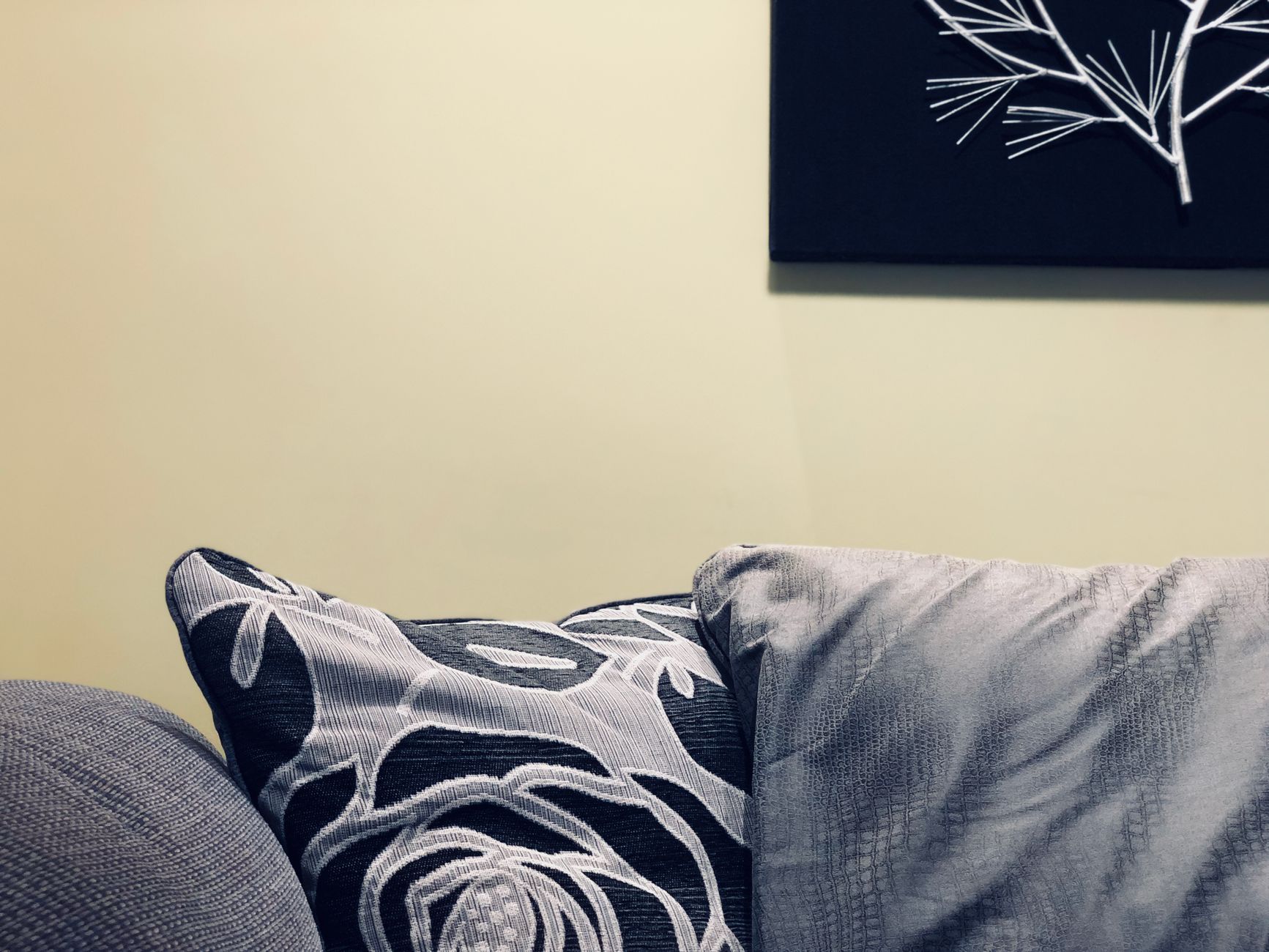 Photo by Chris Jones on Pexels
The most reliable formula is a trio: one solid anchor, one patterned pillow, and one textured pillow. On a sofa with five pillows, you might repeat the solid and the pattern on each end and put the textured one off-center. On a loveseat, the trio alone is plenty.
Color palette made easy
Pull two or three colors from something already in the room: your rug, a piece of art, the curtains. Then distribute them using the 60/30/10 idea. Roughly 60% of your pillows lean on the dominant color (often a neutral), 30% carry a secondary color, and 10% is a bold accent. In practice, on a five-pillow sofa that might mean two oatmeal linen pillows, two blue-and-cream patterned ones, and a single rust velvet lumbar.
Mixing patterns without chaos
Two rules keep patterns friendly:
- Vary the scale. Pair one large-scale print (a big floral or wide stripe) with one small-scale print (a tight check or tiny geometric). Two patterns of the same size fight for attention.
- Share a common color. As long as each pattern contains at least one shared shade, they’ll read as a family.
Texture does the heavy lifting
If you’re nervous about pattern, lean on texture instead. Linen, velvet, boucle, chunky knit, and faux fur all add depth in a single color. An all-cream sofa with a nubby boucle pillow, a smooth linen one, and a knit lumbar looks rich, not boring. For more on combining fabrics across the whole room, see our guide to layering rugs and textiles.
Getting Sizes and Shapes Right
Sizing by furniture
- Large or deep-seated sofas: 20 to 24 inch squares
- Standard sofas: 18 to 20 inch squares
- Accents and chairs: 16 to 18 inch squares, or a lumbar
A common mistake is buying 16-inch pillows for a deep sofa. They get swallowed by the back cushions and you end up adding more to compensate, which is exactly how a sofa ends up with eleven pillows on it.
Mixing shapes
Use squares as your base layer against the back. Add a lumbar (rectangular) pillow in front, which conveniently fills the lower-back gap where you actually sit. If you want a wild card, try a round pillow or a bolster on one end. One unusual shape is charming; three is a pillow shop.
The insert secret
Size your insert up 1 to 2 inches over the cover. A 20-inch cover gets a 22-inch insert. This gives you plump, full pillows that hold their shape and take a satisfying karate chop, instead of limp ones that slump in the corners. Feather or feather-down blends hold this shape best; polyester inserts are cheaper but flatten faster.
How to Arrange Them (Sofa, Sectional, Bed, Chair)
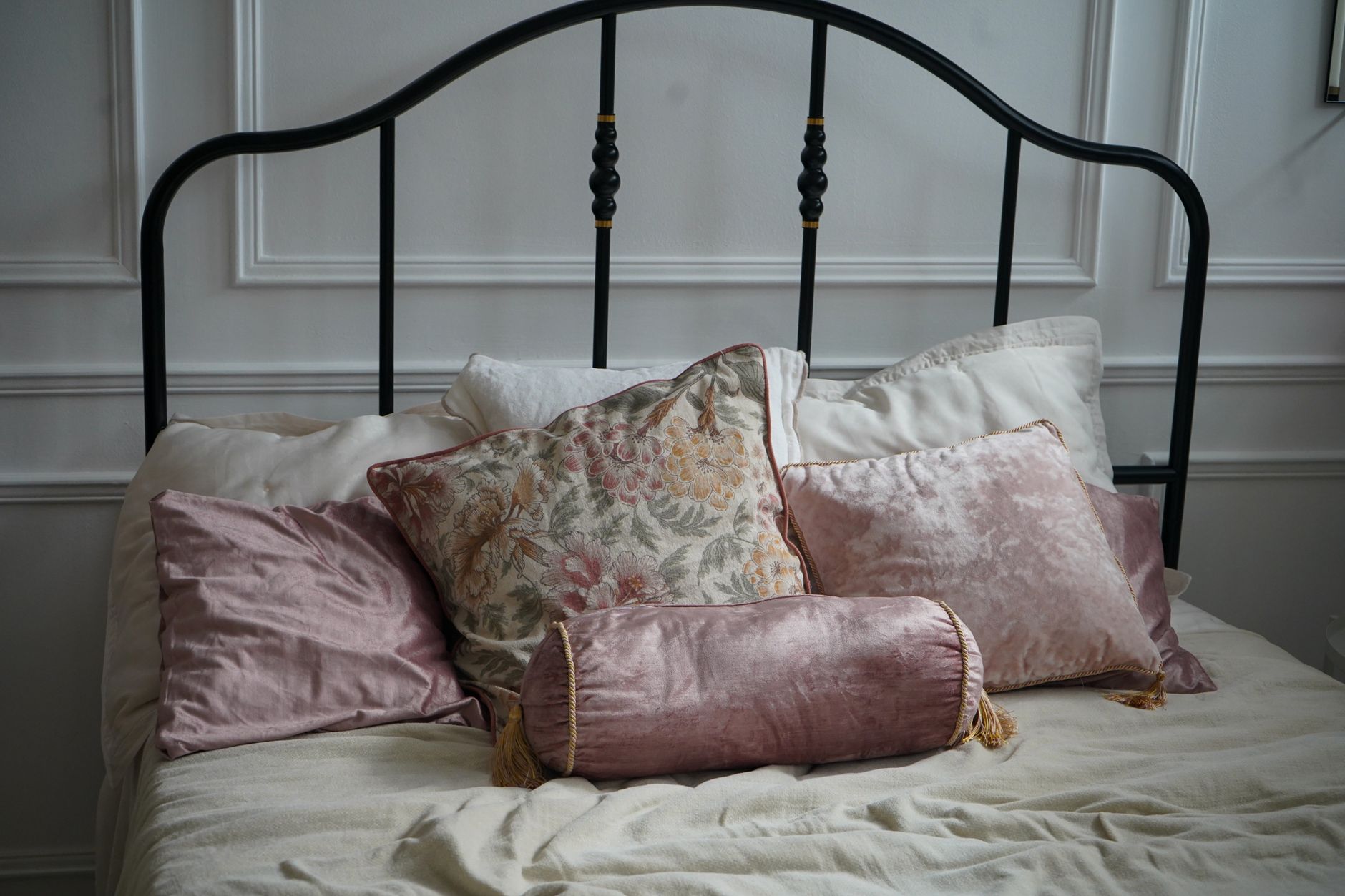 Photo by Наталья Маркина on Pexels
Sofa
Place your largest pillows in the corners, then step down in size toward the center. For a formal look, mirror each end exactly. For a relaxed look, put three on one end and two on the other, or two on one end and a single lumbar on the other.
Sectional
Cluster pillows in the corners (including the inside corner where the two sections meet) and space a few along the long back. Leave the seats themselves open. The deep corner of a sectional is the most coveted spot in the house; don’t bury it.
Bed
Layer back to front: Euro shams or large squares against the headboard, then your standard sleeping pillows in shams, then one lumbar or a pair of small accents in front. On a queen, that might be two Euros, two standards, and one lumbar. Whatever you do, keep the setup simple enough that getting into bed takes seconds, not a full unloading routine.
Chairs and benches
One lumbar on an armchair is almost always enough; a big square can push you to the edge of the seat. On a bench or window seat, a tidy pair (or three in graduated sizes) looks finished without taking over the seating.
Seasonal and Budget-Friendly Throw Pillow Ideas
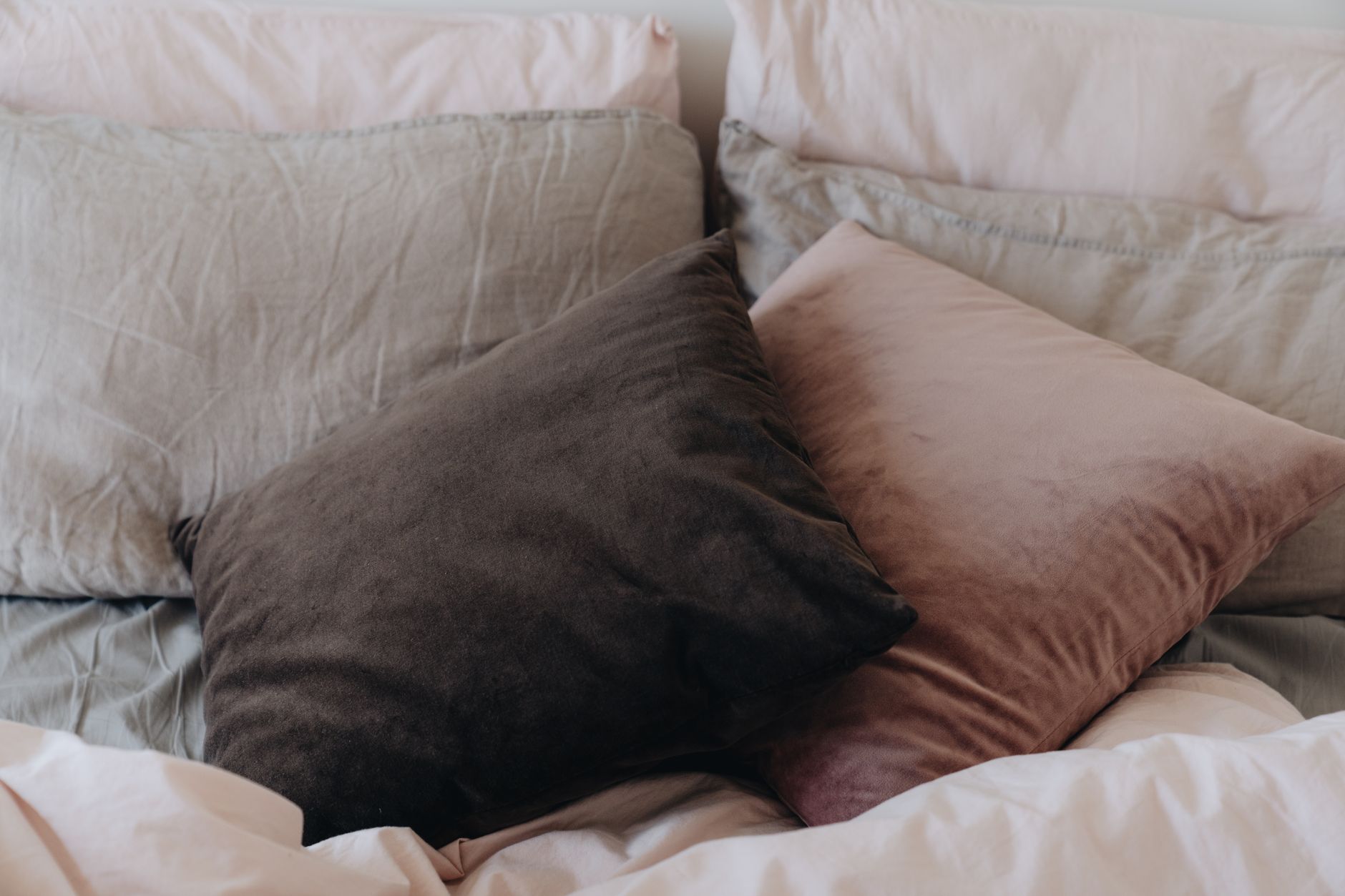 Photo by alleksana on Pexels
Swap covers, not pillows
The smartest money move is to buy one good set of inserts and rotate covers. Covers fold flat, store in a single drawer, and cost a fraction of a full pillow. It’s also a built-in limit: if you only own five inserts, you can only ever have five pillows out.
Seasonal cues
- Spring and summer: lightweight linen and cotton, lighter colors, botanical or striped prints
- Fall and winter: chunky knits, velvet, wool, and warmer tones like rust, mustard, and deep green
Where to spend vs. save
Spend on the inserts. A quality feather-down insert lasts for years and makes even an inexpensive cover look high end. Save on the covers, especially trend-driven ones you’ll likely swap in a season or two.
Throw pillows are only one part of a well-styled room. If you’re working on the rest of the house too, our guide to styling your whole home walks through the bigger picture, and the same “edit until it looks intentional” principle applies when styling a bookshelf.
Frequently Asked Questions
How many throw pillows should be on a couch?
A standard 6 to 7 foot sofa looks best with 4 to 5 throw pillows. A loveseat needs only 2 to 3, and a large sectional can handle 6 to 9. Odd numbers usually create the most relaxed, natural look.
How many throw pillows is too many?
You have too many if you have to move pillows to sit down, if they pile up on the floor every night, or if you can’t see the shape of the sofa behind them. Pillows should make seating more comfortable, not harder to use.
Should throw pillows be in odd or even numbers?
Odd numbers (three or five) feel relaxed and collected, which suits most casual living rooms. Even, symmetrical arrangements work better in formal or traditional rooms where matching pairs echo the rest of the decor.
What size throw pillows should I buy?
Choose 20 to 24 inch squares for large or deep sofas and 18 to 20 inch squares for standard sofas. Add 16 to 18 inch squares or a lumbar pillow in front as accents.
How do you mix and match throw pillows without it looking messy?
Use the solid, pattern, texture formula: one solid anchor, one patterned pillow, and one textured pillow. Make sure every pattern shares at least one common color, and vary the pattern scale so a large print sits beside a small one.
How many pillows go on a bed?
A queen bed looks great with 3 to 5 decorative pillows and a king with 5 to 7, layered from Euro shams in back to a lumbar in front. Keep it manageable enough that you can clear a spot to sleep in seconds.
Why do my throw pillows look flat or sad?
The insert is almost always too small for the cover. Size the insert up 1 to 2 inches (a 22-inch insert in a 20-inch cover) so the pillow fills out fully and holds its shape.
How can I refresh throw pillows on a budget?
Buy quality inserts once, then swap inexpensive covers by season. Covers are cheaper than whole pillows, take up far less storage space, and let you change the look of a room in minutes.
The Bottom Line
The right number of throw pillows is the number that makes your furniture look finished and still lets you sit, sleep, and relax without a daily cleanup routine. Use the cheat sheet as your ceiling, build with one solid, one pattern, and one texture, and give everything the sit test. When in doubt, take one away.
Ready to keep going? Pair these tips with your wider living room decorating plan, and subscribe to Easy Home Updates for a fresh, doable idea in your inbox every week.


