
Bedroom Light Bulb Color: How to Choose the Right One (Kelvin Guide)
You swap in a new bulb, flip the switch, and the room suddenly feels like a hospital hallway instead of the calm place you fall asleep in. Or the opposite happens and everything glows like a cozy hotel room. The difference is almost never the fixture or the brightness. It is one number printed on the box: color temperature. Getting the bedroom light bulb color right is the cheapest, fastest upgrade in the whole room, and it takes about five minutes once you know what to look for.
This guide gives you a no-jargon way to choose. You will get the exact Kelvin range that supports restful sleep, a plain-English take on how warmth and brightness work together, and a simple layered setup you can copy tonight without buying a single new lamp.
The 60-Second Answer (Quick Pick)
For most bedrooms, choose 2700K “soft white.” It is warm, slightly golden, flattering on skin and walls, and it works with your body’s wind-down cues instead of against them. If you want a version of that in one line, here it is: buy 2700K, make sure it is dimmable, and use more than one light source.
Quick-pick cheat sheet:
- Want maximum coziness? 2700K, or even 2200K for accent lights.
- Modern room, want a touch more crispness? 3000K is as cool as you should go.
- Winding down at night anywhere in the room? Avoid 4000K and above. That is daylight and cool white, and it tells your brain it is the middle of the afternoon.
The reason to keep reading is simple. The best bedroom is not lit by one bulb. It is a few warm sources at different heights that you can dim independently, and that setup is easy to build once you understand the numbers.
What “Light Bulb Color” Actually Means (Kelvin, Simply)
Color temperature is measured in Kelvin, written as K on the packaging. Lower numbers are warmer and more golden. Higher numbers are cooler and more blue-white. That is the whole concept.
Here is the everyday ladder:
- 2200K to 2700K: candle glow to soft white. Warm, relaxing, a little amber.
- 3000K: warm white. Still cozy but cleaner, common in newer homes.
- 3500K to 4000K: neutral to cool white. Task lighting, kitchens, garages, bathrooms.
- 5000K and up: daylight. Bright, blue, energizing, good for reading a spreadsheet at noon.
The single biggest point of confusion is worth stating plainly: color is not brightness. Kelvin sets the warmth of the light. Lumens set how bright it is. They are completely independent. A 2700K bulb can be dim and moody or bright enough to fold laundry by. You pick both numbers separately, and most people only ever check one.
Warm vs. Cool Light in the Bedroom
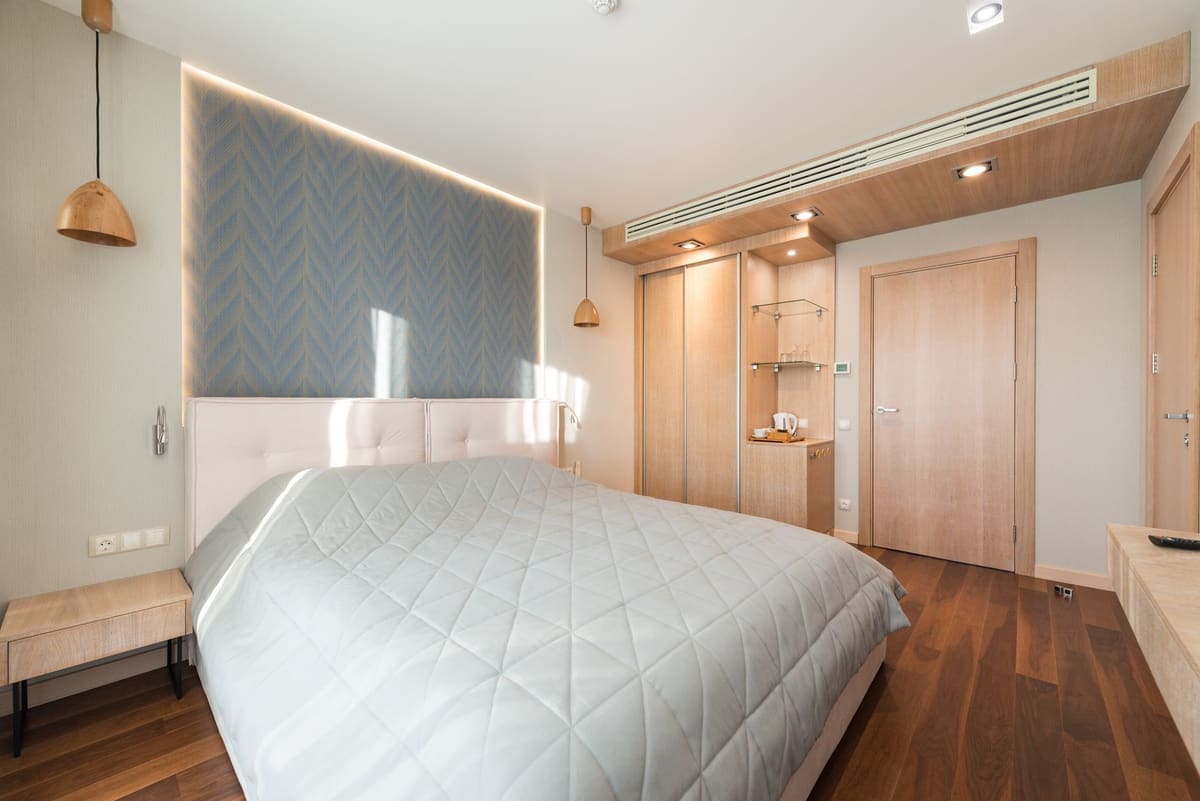 Photo by Max Vakhtbovych on Pexels
Warm light (2700K to 3000K) is the bedroom default for a reason. It is relaxing, it flatters skin tones, it makes wood and fabric look rich instead of washed out, and it eases you toward sleep rather than jolting you awake. If you do nothing else, put warm bulbs in every bedroom fixture.
Cool and daylight light (4000K to 6500K) is not evil. It is genuinely better for focused tasks, detailed hobbies, and getting going in the morning. The problem is that it signals “daytime” to your brain, so it belongs in a home office, a bathroom mirror, or a craft area, not in the space where you are trying to switch off.
The middle ground is 3500K neutral white, and it is only worth considering if your bedroom does heavy double duty as a workspace or a vanity area. Even then, keep it to the desk or mirror and leave the rest of the room warm.
Why Warm Light Helps You Sleep
Your body runs on a roughly 24-hour internal clock, and light is the main thing that sets it. Blue-rich light, the kind that pours out of cool white bulbs, phone screens, and midday sun, suppresses melatonin, the hormone that makes you feel sleepy. Warm, low light does the opposite. It lets melatonin rise on schedule.
The practical rule is easy to follow. In the last one to two hours before bed, shift to warm light and keep it low. That is when a golden 2700K glow earns its keep. You are not trying to sit in the dark, and you are not banishing bright light from your life. You are just making the final stretch of the evening dimmer and warmer than the rest of the day.
If your bedroom currently has a single bright ceiling fixture as its only option, that alone is worth fixing. A room you can only light at full blast is a room that is working against your sleep every night.
Your Layered Bedroom Setup (a Kelvin for Each Spot)
 Photo by Curtis Adams on Pexels
This is where a good bedroom pulls ahead of a merely lit one. Instead of one blanket number, give each layer its own job. For the full picture on fixtures and placement, see our full bedroom lighting plan, but here is the color-temperature version.
- Ceiling or ambient light: 2700K, dimmable. This is your soft overall wash. It should never be the only light you use in the evening.
- Bedside lamps: 2700K, warm and easy to dim low. Bright enough to read by when you want it, gentle enough that turning it on at 2 a.m. does not wake you all the way up. Our guide to bedside lighting ideas covers sizing and fixture choice in detail.
- Reading or task nook, or a vanity: 2700K to 3000K. Nudge toward 3000K only if you do makeup or close detailed work here and need slightly truer color.
- Accent and mood lighting: think wall sconces, LED strips behind the headboard, a salt-lamp style glow. Go as warm as 2200K to 2700K. This is the coziest layer and the one that makes a room feel finished.
The golden rule that ties it together: keep the whole room in one warm family. A room where every source sits between 2200K and 3000K reads calm and cohesive. A room that mixes 2700K on one side and 4000K on the other looks patchy and slightly off, even if you cannot say why.
Dimmable and Smart Bulbs (Get the Best of Both)
 Photo by Riki Risnandar on Pexels
A dimmable warm bulb is the single best value here. It lets you run a lamp bright at 7 p.m. and dial it down to a low glow by 10, all from one fixture, without walking around swapping bulbs. Make sure both the bulb and the switch or plug are rated as dimmable, since pairing a non-dimmable bulb with a dimmer causes flicker and buzz.
Tunable and “DimTone” bulbs go a step further. Some shift automatically warmer as you dim them, mimicking the way a candle or a sunset drops in both brightness and color at once. Smart bulbs add scene presets, so you can have a brighter, slightly cooler “morning” setting and a golden “night” setting on the same bulb, on a schedule or a voice command.
The worth-it check: tunable and smart bulbs are great if your bedroom doubles as an office and you genuinely need cool light some hours and warm light others. If you mostly sleep and read in there, a plain dimmable 2700K bulb covers you for a fraction of the price.
What to Actually Buy (Read the Box)
 Photo by ROMAN ODINTSOV on Pexels
Four numbers on the label tell you everything:
- Kelvin: look for 2700K, or 3000K at the most. This is usually printed near a small warm-to-cool scale on the front.
- Lumens: this is brightness. Around 800 lumens replaces an old 60-watt bulb. For bedside lamps, 400 to 800 lumens is plenty. Ignore the wattage number except as a rough equivalence.
- CRI (Color Rendering Index): aim for 90 or higher. A high-CRI bulb makes your skin, bedding, and paint colors look true rather than slightly grey or sallow.
- Dimmable: yes. Confirm it explicitly on the package.
Two more habits save you grief. Buy the same Kelvin in multipacks so nothing in the room looks mismatched, and check that the bulb base fits your fixture before you leave the store. Common mistakes to skip: shopping by watts instead of lumens, mixing 2700K and 4000K in one room, and putting the brightest bulb in the house directly overhead.
Frequently Asked Questions
What light bulb color is best for a bedroom?
For most bedrooms, 2700K “soft white” is the best choice. It is warm and golden without being dim, and it flatters both the room and the people in it. If your bedroom is modern and you want a slightly crisper look, 3000K warm white is the coolest you should go.
What Kelvin is best for bedroom lighting?
Stay in the 2700K to 3000K range for general bedroom lighting. For accent and mood lights you can drop as low as 2200K. Avoid 4000K and above anywhere you sleep or wind down, since that range reads as daylight.
Is warm white or cool white better for a bedroom?
Warm white is better. It is more relaxing, it supports the natural rise in melatonin that helps you fall asleep, and it makes the space feel restful. Cool white feels like the middle of the day and is better saved for a task area or a mirror.
Is daylight (5000K to 6500K) bad for bedrooms?
It is not harmful, but it works against you in a bedroom. Daylight-toned light suppresses sleep signals and keeps your brain in alert mode. Keep it out of wind-down areas and use it only where you need bright, focused light, like a home office corner.
What color light helps you sleep?
Warm, low, amber-toned light in the 2200K to 2700K range during the hour or two before bed. The goal is light that is both dim and warm, closer to candlelight than to an overhead fixture. Bright light of any color in that final stretch makes falling asleep harder.
Can I mix different color temperatures in one bedroom?
It is best not to. Keeping every source in one warm family, roughly 2200K to 3000K, makes the room feel calm and put together. Mixing 2700K and 4000K in the same room looks patchy and distracting, even when people cannot pinpoint the cause.
What is the difference between color temperature and brightness?
Color temperature, measured in Kelvin, sets how warm or cool the light looks. Brightness, measured in lumens, sets how much light you get. They are independent, so you choose both: a warm 2700K bulb that is also bright, or one that is warm and dim.
Are dimmable or smart bulbs worth it for the bedroom?
A dimmable 2700K bulb is worth it for almost everyone, since it lets one fixture handle both reading and winding down. Full smart or tunable bulbs are worth it mainly if the room doubles as an office and you need cool light during the day.
The Bottom Line
Color temperature is the smallest change with the biggest payoff in a bedroom. Start with 2700K soft white, make sure every bulb is dimmable, and spread the light across a few sources at different heights instead of relying on one fixture overhead. Read the box for Kelvin, lumens, CRI, and the word “dimmable,” buy in matching multipacks, and you are done.
Once the bulbs are sorted, the finishing touches are all about placement and layering. Take a look at our cozy bedroom lighting ideas for the next step, and sign up for the newsletter for more small-change, big-impact home tips.


